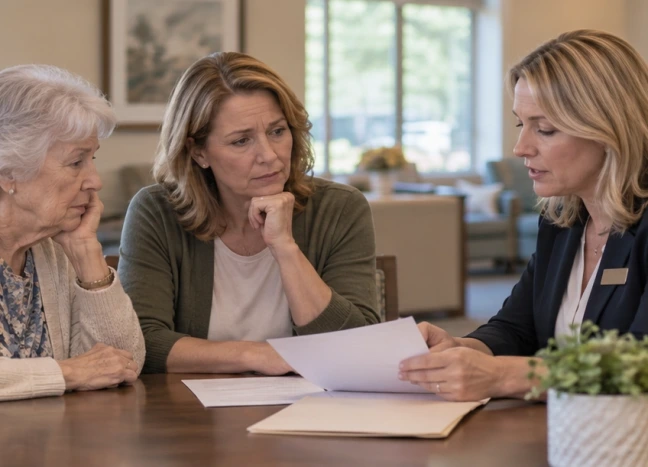


Families often hear the phrase “assisted living” as if it described one uniform type of care. In California, however, many assisted living communities are licensed as Residential Care Facilities for the Elderly, or RCFEs, and they operate under a detailed set of state licensing rules.
Those rules matter because assisted living is not the same as skilled nursing. RCFEs generally provide 24-hour nonmedical care and supervision, help with activities of daily living, meals, medication assistance within legal limits, observation of residents, and arrangements for outside health care when needed. The California Department of Social Services, through Community Care Licensing, licenses and oversees these facilities.
Families do not need to memorize Title 22 to ask good questions. The more useful approach is to understand the rules that most directly affect everyday care. The ten areas below provide a practical framework for evaluating whether an assisted living facility is doing what California expects.
This article provides general information, not legal advice about a particular resident or facility. California regulations can change, and the facts of an individual situation matter.
1. The Facility Must Evaluate Whether It Is an Appropriate Placement
Before admission, a California assisted living facility must gather enough information to determine whether the prospective resident is suitable for the setting. The pre-admission appraisal addresses the person’s background, specific service needs, medical history, and functional limitations. The facility must also obtain a medical assessment completed within the prior year by an appropriate licensed medical professional.
This is more than paperwork. The assessment process should help answer practical questions: Can the resident walk independently? Is help needed with bathing, dressing, toileting, or transfers? Is there dementia? Does the resident need medication assistance? Are there health conditions that the facility can manage only with outside licensed professionals?
If the answers show needs the facility cannot legally or practically meet, accepting the resident anyway can create problems from the start. Our guide to when a California assisted living facility cannot meet a resident’s care needs explains that issue in greater detail.
2. The Resident’s Appraisal Must Change When the Resident Changes
Admission is only a snapshot. California requires the resident’s appraisal to be updated in writing as often as necessary, or at least once every 12 months, so that significant changes are documented and the appraisal remains accurate.
A change may involve physical health, cognition, behavior, mobility, nutrition, personal care, or another area that affects the services the resident needs. The regulations also require corresponding changes in care and supervision when the appraisal changes. When there is a significant change, or at least annually, the facility must arrange a meeting or conference call to share the reappraisal with the resident, the resident’s representative when applicable, and appropriate facility staff.
Current rules also require the facility to request that residents receive a routine visit with a licensed medical professional once every 12 months, either in person or by video appointment, and to document the visit or a refusal in the resident’s record.
This becomes especially important after hospitalization, repeated falls, worsening dementia, new incontinence, significant weight loss, or another decline. Returning to the same routine without meaningful reassessment can leave a resident receiving yesterday’s level of care for today’s needs.
For example, our article on unexplained falls in California assisted living discusses why a fall can be a signal that mobility, supervision, or medication-related risks need to be reconsidered.

3. Staffing Must Be Sufficient for the Residents Who Actually Live There
California’s general staffing rule requires facility personnel to be sufficient in number and competent to provide the services residents need. For families, the practical point is that staffing cannot be evaluated only by looking at the size of the building or a single head count.
A facility serving mostly independent residents may have different demands from one serving people who need extensive help with toileting, transfers, dementia supervision, meals, medication routines, or nighttime care. Current California reappraisal rules also require the facility to evaluate staffing needs in light of each resident’s current appraisal.
Warning signs of a staffing problem can include repeated long waits for toileting assistance, residents routinely missing showers or meals, calls for help going unanswered, rushed transfers, or caregivers repeatedly saying they cannot provide required assistance because they are covering too many people.
Not every delay proves understaffing. What matters is whether staffing is sufficient to provide the services residents have actually been assessed as needing.
4. Basic Services Include More Than a Room and Meals
California defines a set of basic services that RCFEs are expected to provide. These include care and supervision, safe and healthful living accommodations, nutritionally balanced meals and snacks, personal assistance with activities of daily living as needed, regular observation of physical and mental condition, arrangements to meet health needs, and a planned activities program appropriate to residents’ interests and abilities.
This is an important distinction because families sometimes assume that anything beyond housing is an “extra.” The admission agreement may distinguish between basic and optional services, but the facility still has core obligations tied to the resident’s assessed needs.
Basic care is also individualized. One resident may need only meal preparation and occasional reminders. Another may need help dressing, bathing, using the toilet, walking to meals, or safely managing a medication routine.
5. Medication Assistance Has Legal Limits
Assisted living medication practices are often misunderstood. Unlicensed caregivers may assist residents with self-administered medication within California’s rules, but a job title such as “med tech” does not give an unlicensed employee the same authority as a nurse or other licensed professional.
The distinction matters when a resident can no longer manage medication as independently as before. A facility should not quietly expand an unlicensed caregiver’s role beyond what the law permits simply because the resident has become more dependent.
Medication records, current physician orders, proper storage, staff training, and recognition of adverse effects can all become important when something goes wrong. Our article on medication errors in California assisted living facilities explains those requirements in more detail.
6. Dementia Care Requires More Than a Locked Door
California allows RCFEs to care for residents with dementia when the facility is appropriately equipped and staffed to meet their needs. Current rules address dementia-specific training, hydration, nutrition, skin care, communication, activities, behavioral expressions, the physical environment, and assistance with daily living.
That matters because dementia can affect much more than memory. A resident may stop recognizing hazards, forget to use a walker, resist personal care, wander, become frightened, or show sudden behavioral changes caused by pain, infection, dehydration, medication effects, or another underlying problem.
A secured door may reduce elopement risk, but it does not replace person-centered supervision and care. Our guide to memory care neglect in California assisted living covers these issues more fully.

7. The Facility Must Respond Appropriately to Medical Needs and Emergencies
Although RCFEs are not hospitals or nursing homes, they still have responsibilities when a resident needs medical attention. California requires facilities to help arrange appropriate medical and dental care and to assist residents in meeting necessary health needs.
When an injury or other circumstance creates an imminent threat to a resident’s health, including an apparent life-threatening medical crisis, California regulations require the facility to immediately call 911 unless a specific regulatory exception applies.
That does not mean every minor complaint requires an ambulance. Non-emergency situations may be handled through a physician, home health provider, urgent evaluation, telehealth, hospice, or another appropriate professional. The important distinction is whether delay could place the resident in immediate danger.
Our article on when assisted living staff fail to call 911 explains the emergency rule, advance directives, hospice, and non-emergency alternatives.
8. Residents Have Specific Personal Rights
California assisted living residents do not give up ordinary personal rights when they move into a facility. State regulations protect dignity, safe and comfortable accommodations, freedom from punishment, humiliation, intimidation, and abuse, the ability to keep and use personal possessions, confidential telephone calls and correspondence, and private visits with family, ombudspersons, and advocacy representatives during reasonable hours.
Residents also have the right to receive or reject medical care or other services. Privately operated RCFEs have additional protections that include a reasonable level of personal privacy in accommodations, medical treatment, personal care and assistance, visits, communications, and resident or family-group meetings.
Families should pay attention when staff use threats, humiliation, unnecessary isolation, punitive restrictions, or interference with eating, sleeping, toileting, communication, or personal belongings as a way to control behavior. Those concerns can involve more than poor customer service; they may implicate specific resident rights.
9. An Assisted Living Facility Cannot Simply Tell a Resident to Leave Whenever It Wants
California limits the grounds an RCFE may use for eviction and imposes notice requirements. Common grounds can include nonpayment, certain violations of law or written facility policies, a newly identified care need that makes the facility inappropriate after reappraisal, or a change in the use of the facility.
For the first four ordinary eviction grounds listed in California’s regulation, 30 days’ written notice is generally required. A three-day notice is available only in limited circumstances and requires prior written approval from the licensing agency based on good cause involving a threat to health or safety. An eviction based on a change in the use of the facility requires no less than 60 days’ written notice.
The details matter because a statement such as “your mother needs too much care” does not, by itself, answer whether the facility followed the required appraisal and eviction process. Our article on California assisted living eviction rules explains the notice requirements and available protections in more detail.
10. Families Can Review Licensing History, File Complaints, and Contact the Ombudsman
California families are not limited to asking the facility for its version of events. Community Care Licensing maintains a public Facility Search website with five years of information on licensed facilities, and complaint investigation reports are available through the system. Additional facility-file information, including more detail about citations or prior licensing history, may be requested from the appropriate regional office.
The state cautions families not to rely on the online record alone when choosing or evaluating a facility. An in-person visit, current licensing information, the resident’s actual needs, and questions about staffing and services can provide context that a regulatory history by itself cannot show.
If a family believes a facility is violating licensing requirements, a complaint can be made to the California Department of Social Services, Community Care Licensing Division. The current CCLD complaint line is 844-538-8766, also presented by the state as 844-LET-US-NO.
Residents and families may also contact the California Long-Term Care Ombudsman. Ombudsman representatives advocate for residents, assist with day-to-day care and rights concerns, and investigate complaints involving long-term care settings. The statewide Ombudsman hotline is 1-800-231-4024 and is available 24 hours a day.

How Families Can Use These Rules in Real Life
The most useful question is rarely, “Did the facility violate a regulation?” in the abstract. A better starting point is to compare what the resident needed with what the facility knew, promised, documented, and actually provided.
If a problem occurs, families may find it helpful to organize the situation around a few practical questions:
- What did the resident’s most recent appraisal say?
- Did the resident’s condition change before the incident?
- Was the care plan or level of supervision adjusted?
- Were enough appropriately trained staff available?
- Were medication, dementia, mobility, nutrition, or emergency needs handled within the facility’s role?
- Were the resident’s rights respected?
- Do the facility’s records and explanations match what the family observed?
- Was a licensing complaint, Ombudsman request, or other outside review appropriate?
One problem does not automatically establish abuse or neglect. Serious concerns become more meaningful when there is a pattern of unmet assessed needs, repeated failures to respond to changes, unsafe practices, inconsistent records, or harm that follows a preventable lapse in care.
When a Regulatory Concern May Also Raise a Legal Question
A licensing violation and a civil elder-abuse or negligence claim are not the same thing. A facility can violate a regulation without causing compensable harm, and a serious legal claim may involve facts that go beyond a single licensing rule.
When a resident suffers a serious injury, hospitalization, unexplained decline, or other harm, a legal review may examine the regulations alongside the resident’s appraisals, medical records, facility notes, staffing information, incident reports, and outside health-care records.
Newman Law Group represents residents and families in Sacramento and throughout Northern California in matters involving assisted living abuse and neglect, memory care, medication errors, falls, inadequate supervision, delayed medical response, and other failures of care.
Contact Newman Law Group to discuss a serious assisted living abuse or neglect concern, or call 9169320397.
This article provides general legal and care information and is not legal or medical advice for a particular resident or facility. Licensing requirements and legal rights can depend on the facts, the resident’s condition, and the services involved.