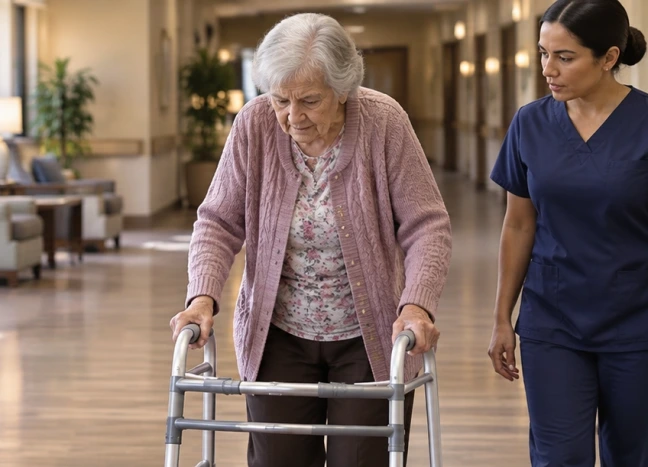


Assisted living residents are often older adults with chronic medical conditions, mobility limitations, dementia, or other vulnerabilities. Staff may be the first people to see that a resident is having trouble breathing, showing signs of a stroke, experiencing severe pain, or becoming suddenly weak or unresponsive. In those moments, deciding whether to call 911 can have serious consequences.
California’s rule is direct when the danger is immediate. If an injury or other circumstance has resulted in an imminent threat to a resident’s health, including an apparent life-threatening medical crisis, the facility must immediately telephone 911 unless a specific regulatory exception applies.
That does not mean every complaint, minor injury, or change in condition requires an ambulance. California also recognizes alternatives for non-imminent situations, including evaluation by an appropriate health professional, telehealth, urgent care, non-emergency transportation, hospice, or a primary care provider. The key distinction is whether the resident is facing an imminent threat that requires emergency response.
This article provides general information about emergency response in California assisted living facilities. It is not medical or legal advice for a particular resident or event.
California Requires an Immediate 911 Call for an Imminent Threat
California Code of Regulations section 87465 requires a facility to immediately call 911 when an injury or other circumstance has resulted in an imminent threat to a resident’s health, including an apparent life-threatening medical crisis, unless one of the limited exceptions involving advance directives, hospice, or qualified health professionals applies.
In June 2025, the California Department of Social Services issued specific guidance to assisted living providers about this requirement. The guidance emphasizes timely emergency care and identifies symptoms and conditions for which an immediate 911 call is recommended as a best practice.
Examples include:
- Severe difficulty breathing that does not improve with rest
- Chest pain
- Signs of stroke, such as facial drooping, weakness, numbness, speech difficulty, confusion, vision changes, or severe headache
- Prolonged or unexplained loss of consciousness
- Heavy bleeding that does not stop with direct pressure
- Choking
- New seizures or a prolonged seizure
- Suspected poisoning or overdose
- Sudden severe dizziness, weakness, difficulty standing or walking, or a major change in mental clarity
- Falls with suspected head injury
- Obvious broken bones
- Falls followed by pain or loss of range of motion
- Sudden severe or unexplained pain
- Moderate or severe burns
The list is not exhaustive. A resident can have a medical emergency that does not fit neatly into one of those examples. California’s guidance tells facilities to use judgment and states that, when in doubt, they should call 911.
Assisted Living Staff Are Not Expected to Diagnose the Emergency
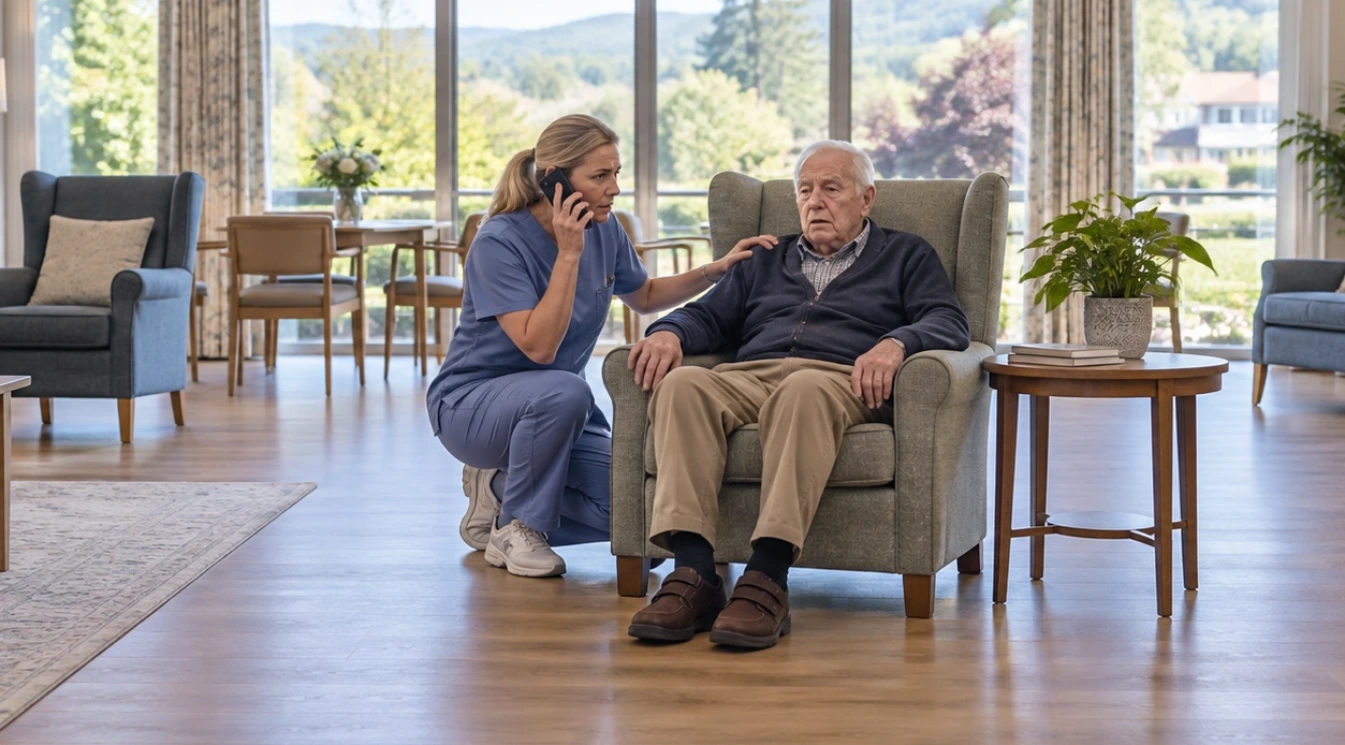
Assisted living is not a hospital, and ordinary caregivers are not expected to determine a medical diagnosis before seeking emergency help. A staff member does not need to know whether weakness is caused by a stroke, infection, medication problem, dehydration, or something else before recognizing that the resident may need urgent evaluation.
California’s 2025 guidance notes that an onsite nurse, EMT, paramedic, or other licensed health professional acting within the person’s scope of practice may help determine whether a condition presents an imminent threat if that professional is readily available. The guidance does not make such an evaluation a prerequisite to calling 911 when the resident is already facing an apparent emergency.
In an assisted living setting, recognizing danger and obtaining appropriate help can be more important than identifying the exact cause.
When Non-Emergency Medical Options May Be Appropriate
Not every medical concern is an imminent threat. For non-emergency situations, California’s guidance identifies several alternatives that may be appropriate depending on the resident’s condition.
Those options can include:
- An onsite appropriately skilled professional or other licensed health professional
- A mobile X-ray technologist or sonographer
- Telehealth
- An EMT or paramedic evaluation
- Non-emergency transportation to urgent care or an emergency department
- A Program of All-Inclusive Care for the Elderly provider
- A hospice provider
- The resident’s primary care physician
The existence of those alternatives does not turn an emergency into a routine office call. If the condition becomes an imminent threat, or staff are uncertain whether the resident is safe, California’s guidance recommends prioritizing emergency medical attention.
A DNR or POLST Does Not Automatically Mean “Do Not Call 911”
Advance-care documents are a frequent source of confusion. A resident may have an Advance Health Care Directive, a Physician Order for Life-Sustaining Treatment, commonly called a POLST, or a Do-Not-Resuscitate form in the facility record.
Those documents express or document the resident’s medical preferences, but the existence of a DNR does not automatically mean facility staff should do nothing during a medical emergency. California regulations set out specific procedures for residents who have an advance directive or request regarding resuscitative measures on file.
One permitted response is to immediately call 911, present the document to responding emergency personnel, and identify the resident to whom it applies. Another option exists when a physician, registered nurse, or licensed vocational nurse is physically present during the emergency, receives the document, and assumes responsibility.
There is also a specific hospice exception. When a terminally ill resident is receiving hospice services, has the appropriate advance directive or resuscitation document, and is showing signs of impending death directly related to the expected course of the terminal illness, the facility may immediately notify the hospice agency instead of calling 911. If the emergency is unrelated to the expected course of the terminal illness, the regulation requires an immediate 911 call.
The distinction matters because “DNR” refers to resuscitation preferences; it is not a general instruction to ignore every medical emergency.
Residents Still Have the Right to Refuse Treatment or Transport
California’s 2025 guidance also addresses an important resident-rights issue. There may be situations in which a resident, or an authorized representative when applicable, does not want the facility to call 911. If the circumstances meet the regulation’s imminent-threat standard, however, the facility is still required to make the emergency call unless a specific exception applies.
Calling 911 does not eliminate the resident’s right to make decisions about medical care. California regulations protect a resident’s right to receive or reject medical care or other services. That can include declining treatment or hospital transport when the resident has legal authority to make that decision.
This is one reason staff should not confuse the facility’s obligation to summon emergency help with the separate question of what treatment the resident ultimately accepts.
Delaying the Call to Contact Family Can Create Risk
Families can be important sources of medical history and may need to be notified when a resident’s condition changes. But when the circumstances meet California’s imminent-threat standard, the regulation requires the facility to call 911 immediately unless a specific exception applies.
In other words, contacting family is not a substitute for the required emergency call. Notifications to a representative, physician, hospice provider, or other person may still be appropriate, but they serve a different purpose from summoning emergency assistance.
Changes in Condition Can Become Emergencies
Some emergencies begin with subtle changes. An older resident may first appear unusually tired, confused, weak, unsteady, or less responsive than normal. Those changes can be easy to attribute to age, dementia, poor sleep, or a chronic condition.
The problem is that similar symptoms can also accompany stroke, infection, dehydration, medication effects, internal bleeding, low blood sugar, or other potentially serious conditions. Staff who know the resident’s usual behavior and abilities may be in a good position to recognize when something is genuinely different.
Our article on when an assisted living facility cannot meet a resident’s care needs discusses the broader obligation to reassess residents and respond when physical or cognitive needs change.
Medication Problems May Trigger an Emergency Response
Medication errors and adverse effects can sometimes produce sudden symptoms, including severe weakness, sedation, dizziness, altered mental status, abnormal blood pressure, or loss of consciousness. A medication issue can also become dangerous when an important dose is missed or the resident receives the wrong drug.
Facility staff are not expected to diagnose whether medication caused the problem before seeking emergency help. The severity of the resident’s condition is what matters in the moment.
Our article on medication errors in California assisted living facilities explains California’s separate rules concerning medication assistance, staff training, PRN medications, injections, storage, and documentation.
A “Lift Assist” Is Different From a Medical Emergency
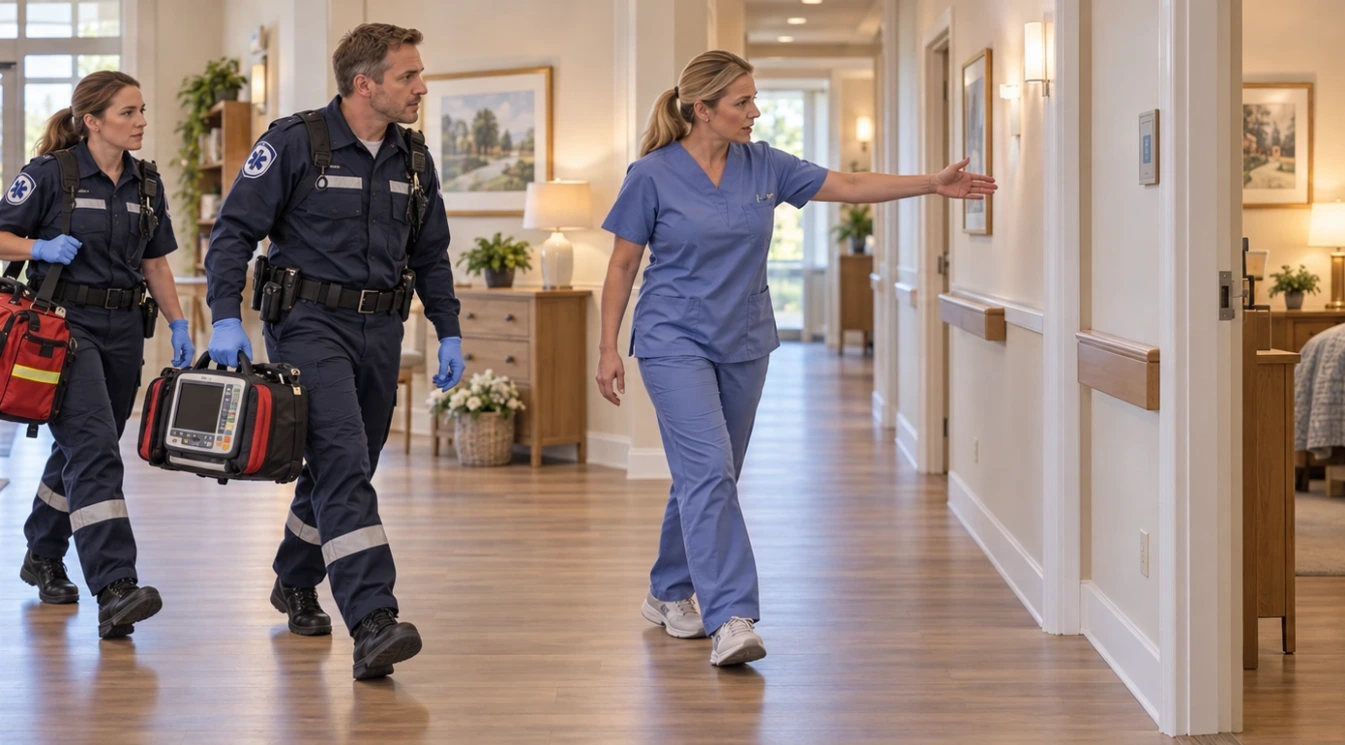
California’s 2025 guidance also addresses calls to emergency services simply to help a resident get up. A “lift assist” is described as a situation in which a resident needs help moving or transferring but there are no signs of injury or medical concern.
Facilities are responsible for having sufficient staff who are trained and equipped to assist residents safely with mobility and transfers. California’s guidance states that calling 911 solely for a lift assist is not appropriate when it has been determined that the resident has not sustained an injury.
At the same time, a fall should not automatically be treated as harmless. Older adults can suffer fractures, head injuries, internal injuries, and other complications that are not immediately obvious. California’s guidance specifically identifies falls involving suspected head injury, pain, or loss of range of motion as situations in which emergency care may be warranted.
The practical distinction is between a resident who simply needs safe mobility assistance and a resident who may have been injured or is showing signs of medical distress.
Emergency Planning Should Exist Before a Crisis Happens
California assisted living facilities are required to maintain basic emergency information, including readily available physician information and emergency-agency contact information. In facilities licensed for 16 or more residents, one or more employees must be designated as having primary responsibility for helping ensure that residents receive needed first aid and emergency medical services.
Preparation matters because a crisis is a poor time to determine who is responsible for calling 911, where the resident’s POLST is kept, which medications the resident takes, or who should meet emergency responders at the door.
Useful emergency procedures may address:
- How staff recognize and escalate a medical emergency
- Who calls 911 and who stays with the resident
- How emergency responders gain immediate access to the resident
- Where medical information and advance-care documents are kept
- How medications and current medication lists are communicated
- Who contacts family, the resident’s representative, or hospice when appropriate
- How the incident and the resident’s condition are documented afterward
California’s 2025 guidance also points to staff training in the appropriate response to emergencies. Clear procedures and trained staff can reduce confusion when minutes matter.
Warning Signs That Emergency Care May Have Been Delayed
After a serious medical event, families may have questions about whether the facility recognized the problem and acted promptly. Concerns may arise when:
- Staff delayed calling 911 despite symptoms consistent with an apparent medical emergency
- Staff treated family notification as a substitute for an emergency call when the resident appeared to face an imminent threat
- Severe symptoms were attributed to dementia or aging without timely medical evaluation
- A resident with stroke-like symptoms was told to rest and was not evaluated promptly
- Staff used a DNR as a reason not to seek any emergency assistance
- A resident fell and reported significant pain, but the event was treated only as a routine lift assist
- Different employees give conflicting accounts of when symptoms began or when 911 was called
- The facility lacks a clear timeline documenting the resident’s condition and emergency response
- Similar warning signs occurred earlier without meaningful reassessment or medical follow-up
None of those circumstances automatically establishes neglect. The resident’s condition, applicable advance-care documents, available clinical information, staff observations, and the timing of the response all matter.
Records Can Help Reconstruct the Emergency Timeline
When there is a dispute about delayed emergency care, the timeline can be critical. Useful information may include:
- Caregiver and shift notes
- Incident reports
- 911 call records and dispatch times
- Ambulance and paramedic records
- Emergency department and hospital records
- Medication records
- Vital signs or other observations documented before the transfer
- Text messages, emails, and telephone records involving the family
- Advance directives, POLST forms, or DNR documentation
- Hospice records when hospice was involved
- Staff schedules and assignments
- Facility emergency-response policies and training records
The sequence may show when the resident first developed symptoms, who observed them, what staff did, when outside help was contacted, and how the resident’s condition changed while waiting for care.
Our guide to preserving evidence after suspected elder abuse or neglect discusses additional records and documentation that can help establish what happened.
When a Failure to Call 911 May Point to Assisted Living Neglect
A poor medical outcome does not by itself mean that an assisted living facility responded negligently. Some emergencies develop rapidly, symptoms may initially be ambiguous, and even immediate treatment cannot prevent every serious outcome.
Concerns become more significant when the resident showed signs of an imminent health threat and the facility delayed emergency assistance without an applicable exception, failed to respond to serious symptoms, or treated a worsening emergency as a routine care problem.
Newman Law Group represents residents and families in matters involving elder neglect, delayed medical care, assisted living emergencies, medication-related harm, inadequate supervision, and failures to respond appropriately to changes in condition.
Contact Newman Law Group to discuss a serious assisted living emergency or delayed-care concern, or call 9169320397.
This article provides general legal and care information and is not advice for a particular resident, medical event, or facility. Whether 911 is required depends on the resident’s condition and the circumstances, and advance directives, hospice status, and the involvement of licensed health professionals can affect the applicable procedure.