
Choosing a nursing home is rarely a simple comparison of location, appearance, and price. A facility may have an attractive lobby and a reassuring tour while its public records reveal repeated staffing problems, serious deficiencies, or unresolved patterns of poor care. The reverse can also be true: an older building may have stable staff, responsive leadership, and a record that compares favorably with nearby facilities.
Families researching a Sacramento nursing home should use several sources together. Government ratings can narrow the field, inspection reports can reveal recurring problems, ownership information can show whether a facility is part of a larger chain, and an in-person visit can provide context that databases cannot. Our earlier article about what to look for in a good nursing home offers a useful starting point; the steps below explain how to conduct a more detailed review using the information now publicly available.
Begin With the Resident’s Actual Care Needs
A nursing home should not be evaluated in the abstract. The relevant question is whether the facility can safely meet the needs of the particular resident. Before comparing ratings, make a written list of the services and assistance the person requires now and may reasonably need in the near future.
- Mobility, transfers, fall prevention, and toileting assistance
- Wound care, injections, oxygen, dialysis coordination, or other skilled services
- Dementia care, wandering precautions, behavioral support, or secured outdoor access
- Feeding assistance, swallowing precautions, special diets, and hydration monitoring
- Physical, occupational, or speech therapy
- Language, cultural, religious, and communication needs
- Transportation to specialists and outside medical appointments
A high overall rating does not establish that a facility has the staff, equipment, or experience to handle every condition. Ask the resident’s physician, hospital discharge planner, therapist, or social worker which services are essential and which questions should be answered before admission.
Use Medicare Care Compare as a Starting Point
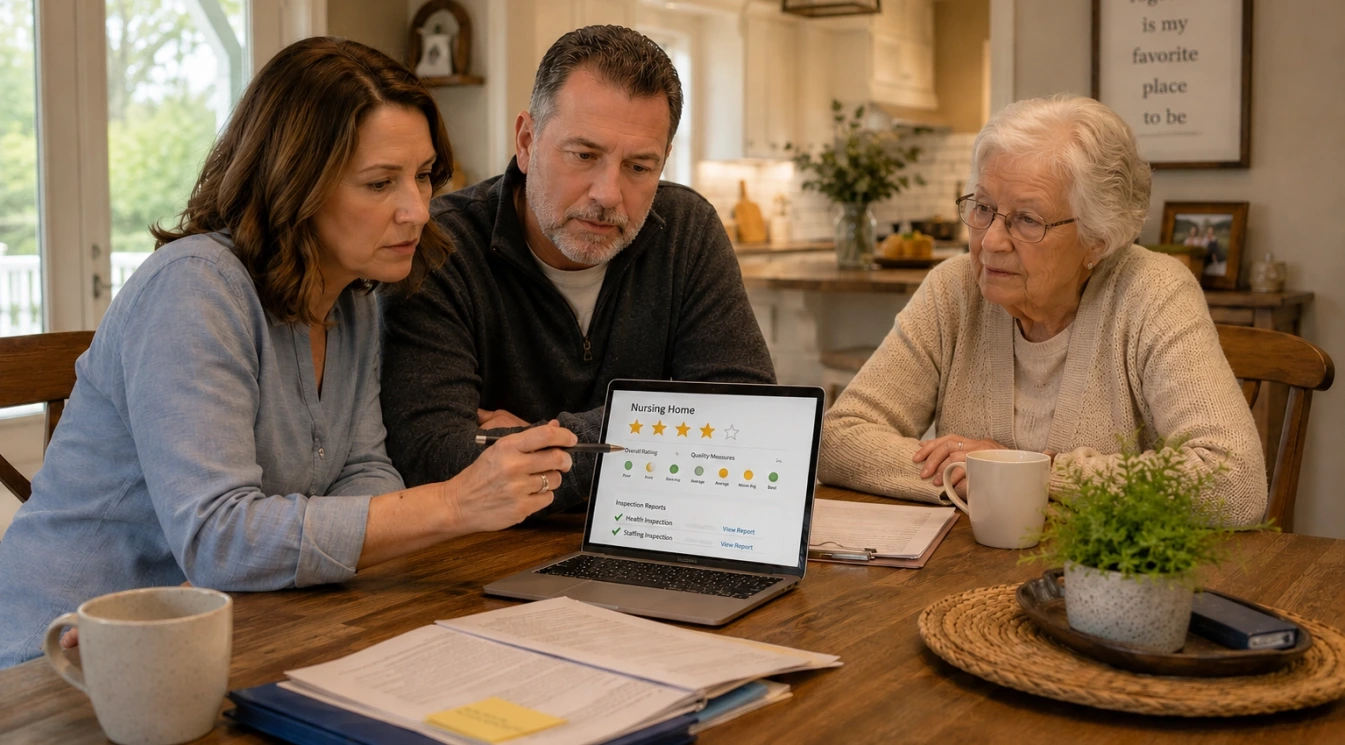
Medicare Care Compare allows families to search and compare Medicare-certified nursing homes by location. Its one-to-five-star system includes an overall rating and separate ratings for health inspections, staffing, and quality measures. The separate ratings matter because two facilities with the same overall score may have very different strengths and weaknesses.
Care Compare is useful for creating a shortlist, but it should not be treated as a final verdict. CMS itself cautions that no rating system captures every consideration, including specialized services, proximity to family, and the fit between a facility and a particular resident. Facilities that are not Medicare- or Medicaid-certified may not appear in the federal comparison tool.
Read the Inspection Reports Behind the Stars
The health-inspection rating reflects findings from comprehensive surveys, complaint investigations, and certain focused inspections. Do not stop at the star score. Open the inspection results and read the descriptions of the deficiencies.
For each finding, consider:
- What occurred? A paperwork problem is different from a failure involving resident supervision, medication, infection control, nutrition, or abuse prevention.
- How serious was it? Review whether residents experienced harm or were placed at risk of significant harm.
- How widespread was it? Determine whether the finding involved one unusual event or a system affecting multiple residents.
- Has it happened before? Similar citations across several surveys may be more concerning than an isolated finding that was promptly addressed.
- What happened afterward? Review the plan of correction and any later survey information showing whether the problem recurred.
Inspection reports are snapshots of conditions observed during particular visits. A clean recent survey does not guarantee that a problem has never occurred, and an older citation does not necessarily describe current care. Patterns, severity, and the facility’s response are more informative than the raw number of deficiencies.
Check California Records Through Cal Health Find
The California Department of Public Health maintains Cal Health Find for licensed and certified health care facilities. A facility profile may include ownership, licensing and certification status, complaints, facility-reported incidents, state enforcement actions, and deficiencies identified by state surveyors. The database also makes approved Statements of Deficiencies and Plans of Correction available for skilled nursing facilities.
Cal Health Find and Medicare Care Compare overlap, but they are not identical. Reviewing both can reveal details that are easier to find in one system than the other. Search by the facility’s exact legal name, address, and license information so that similarly named locations are not confused.
Complaint totals require context. Cal Health Find generally displays complaints and facility-reported incidents after the investigation has concluded. A recent concern may therefore be absent while an investigation remains open. The date shown may also reflect when CDPH received the complaint rather than when the underlying event occurred.
Look Closely at Staffing and Turnover
Staffing information can help families evaluate whether enough nursing time may be available to meet residents’ needs. Care Compare reports nursing staff hours per resident per day and information about staff turnover. Those figures are averages; they do not show exactly how many employees will be present on a particular shift or how much care one resident will receive.
Compare facilities rather than viewing one number in isolation. Pay attention to registered-nurse coverage, total nursing hours, weekend patterns, and turnover among nursing staff and administrators. Frequent turnover may disrupt continuity because new employees need time to learn residents’ conditions, preferences, care plans, and warning signs.
During a tour, ask how staffing changes by shift and resident census. A facility should be able to explain how it covers call-outs, vacations, hospital returns, residents whose conditions worsen, and units requiring more assistance. For a deeper discussion of how staffing shortages affect resident care, see our information about nursing home neglect.
Research Ownership and Affiliated Facilities
The name on a building may not identify the company that owns or operates it. Care Compare and Cal Health Find provide ownership information, and Care Compare may show performance information for affiliated entities or facilities within the same chain.
Ownership research can answer useful questions:
- Is the facility independently owned or part of a regional or national chain?
- Has ownership or management changed recently?
- Do affiliated facilities show similar staffing, inspection, or enforcement patterns?
- Is the administrator experienced at this location, or has leadership changed repeatedly?
A chain affiliation is not inherently positive or negative. Larger operators may offer standardized systems and resources, while local operators may provide more direct oversight. The value of ownership information lies in identifying patterns and knowing who is responsible for operations.
Understand What Quality Measures Can and Cannot Show
Quality measures summarize performance in selected areas for short-stay and long-stay residents. Depending on the measure, the data may address falls with major injury, hospitalizations, pressure ulcers, antipsychotic medication use, pain, vaccination, mobility, or other outcomes.
Use measures that relate to the prospective resident’s needs. A family seeking short-term rehabilitation may focus on different information than a family seeking long-term dementia care. Also remember that quality measures describe averages across groups of residents. They do not explain the circumstances of a single event or guarantee how a new resident will be treated.
Visit More Than Once and Observe Ordinary Care
A scheduled tour is important, but one polished visit may not show how the facility functions during meals, evenings, weekends, or shift changes. When possible, request another visit at a different time. Observe without interfering with residents’ privacy or care.
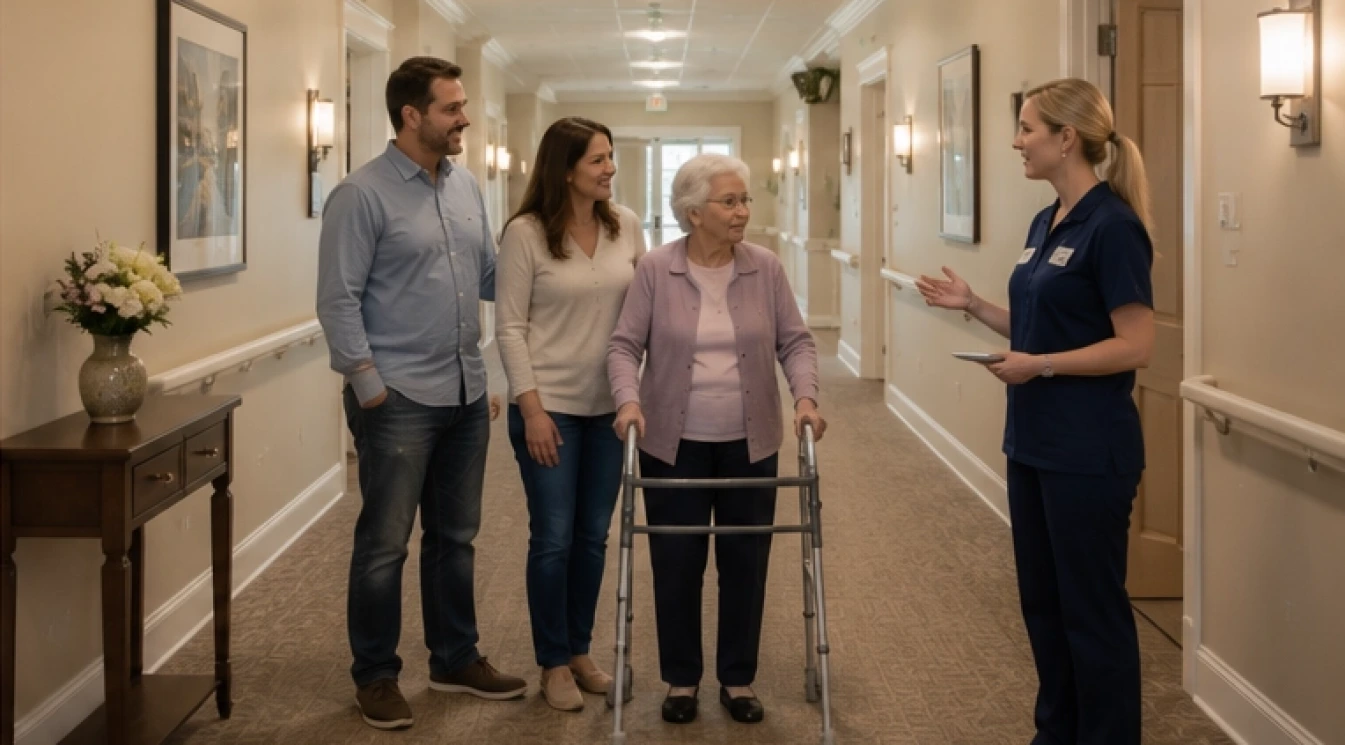
- Resident appearance and interaction
- Do residents appear clean, appropriately dressed, and engaged?
- Do staff address residents respectfully and explain what they are doing?
- Are residents left calling for help or sitting in uncomfortable positions?
- Response and supervision
- How quickly are call lights answered?
- Are residents who need transfer assistance being helped by the appropriate number of staff?
- Are hallways and common areas supervised without feeling unnecessarily restrictive?
- Environment and daily life
- Are rooms, bathrooms, equipment, and dining areas reasonably clean?
- Are meals served at appropriate temperatures, with assistance available?
- Do activities appear meaningful and accessible to residents with different abilities?
Strong odors, unanswered calls, rushed transfers, residents asking repeatedly for help, or staff who appear unable to answer basic questions deserve follow-up. One observation may have an innocent explanation, but several consistent warning signs should not be dismissed.
Ask Questions That Require Specific Answers
General questions often produce general assurances. Ask how the facility would handle realistic situations involving the prospective resident.
- Who completes the initial assessment, and how quickly is the care plan developed?
- How are changes in condition communicated to physicians and family representatives?
- What happens after a fall, medication error, new wound, significant weight loss, or behavioral change?
- How does the facility investigate complaints and inform families of the outcome?
- Which services are provided on-site, and which require outside transportation?
- How are agency or temporary staff oriented to residents’ care plans?
- Who should a family contact during nights and weekends?
Write down the names and roles of the people who answer. Vague, inconsistent, or defensive responses may be as informative as the answer itself.
Speak With Residents, Families, and the Ombudsman
Current residents and frequent visitors can describe daily conditions that may not appear in public records. When appropriate, ask whether staff respond, whether personal items go missing, whether meals and assistance are dependable, and whether complaints are taken seriously. Respect privacy and do not ask residents to disclose medical information.
California’s Long-Term Care Ombudsman Program advocates for residents of long-term care facilities and may provide general information about resident rights, complaints, and local resources. An ombudsman cannot select a facility for a family, but the program can help families understand what to ask and where concerns may be reported.
Keep a Written Comparison Before Making the Decision
Create a short comparison for the facilities under serious consideration. Record the inspection patterns, staffing data, ownership, specialized services, distance from family, tour observations, costs, and unanswered questions. A written comparison reduces the chance that an attractive room or persuasive salesperson will outweigh more important concerns.
Before signing admission documents, read them carefully and ask for explanations of provisions you do not understand. Keep copies of the agreement, rate sheets, resident-rights notices, inventory forms, and written promises concerning services.
If Concerns Arise After Admission
Even careful research cannot guarantee that neglect or abuse will never occur. Continue visiting, participate in care-planning meetings, monitor changes in condition, and raise concerns promptly. Warning signs may include repeated falls, unexplained injuries, poor hygiene, dehydration, weight loss, untreated wounds, excessive sedation, fear of particular staff members, or abrupt changes in behavior.
If a loved one may be experiencing nursing home abuse or neglect, protect the resident’s immediate health and document what you observe. Newman Law Group can review the circumstances and explain the legal options that may be available. Contact the firm or call 9169320397.
This article provides general information and is not legal or medical advice. Facility ratings and public records can assist with research, but every resident’s needs and every nursing home are different.